Editing Wedding Speeches: What to Keep and Cut
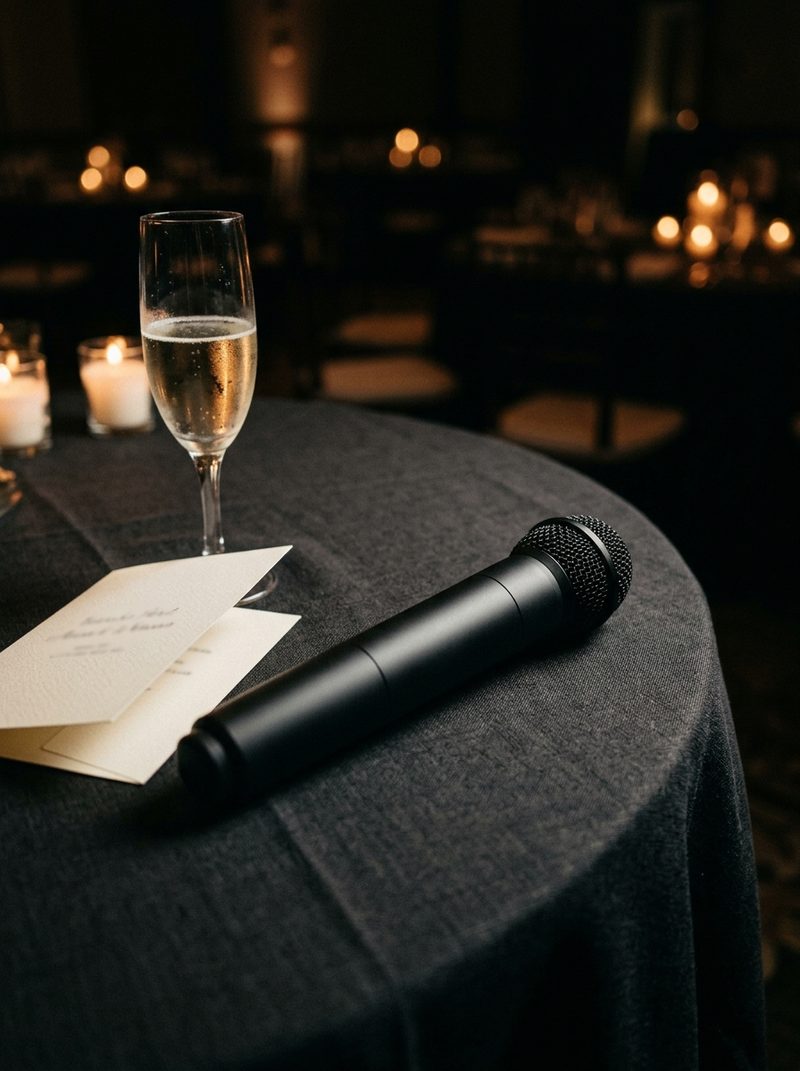
A wedding speech ends up in two places, and each needs the opposite rule. In the speeches edit, keep every word and cut only what is not the speech. In the highlight film, choose a line or two that carry the story and leave out everything else, including the good jokes.
Nearly all of the advice written about wedding toasts is for the person giving one: how long to talk, what to say, what to avoid. The editor's questions are different. Which version of each speech exists, what comes out of it, and who gets to decide.
Should the speeches edit be complete or trimmed?
Complete. Families watch the full speeches for the people, not for the pacing, and a speech with a missing section is a speech someone will notice has a missing section.
Complete does not mean untouched. Take out what is not the speech itself:
- The walk to the microphone and the handoff between speakers.
- Feedback, a dropped microphone and the DJ's announcements.
- Long dead air before someone finds their place.
Keep the stumbles, the laughs and the moment someone had to stop. Those are the parts people rewatch.
Give each speech its own chapter in running order, with the speaker's name spelled the way the couple spells it. Cut between the speaker and the couple's reactions wherever a second angle allows, because the reactions are most of what a second angle is for during speeches.
This is a start to finish edit, and it is priced that way: our speeches only edit is $75.
How do you choose lines for the highlight?
Look for lines that still work when lifted out of the speech. A good highlight line is:
- About the couple, not the speaker.
- Specific. A real story beats a general compliment every time.
- Complete on its own, without the setup from earlier in the speech.
- Recorded cleanly enough to play over music. A line lost in room noise is not a highlight line, however good it was, and what can be recovered is covered in our guide to wedding audio.
- Placed where the film needs it. A laugh early and sincerity late is a shape that works far more often than it fails.
Transcribe every speech before choosing. Searching text is far faster than scrubbing audio, and it is the least risky use of AI in a wedding edit.
A highlight built around speech lines is a dialogue edit and is priced as one. Music plus dialogue starts at $599 for three minutes.
What should come out of the highlight?
By default, anything that needs an explanation or could hurt someone. All of these can stay in the complete speeches edit and still be left out of the highlight:
- References to exes or past relationships, including the ones meant as jokes.
- Inside jokes that only one table understood.
- Stories the couple may not want replayed at every family gathering.
- Swearing, if the film will be shared with family or posted publicly.
The highlight is the version that gets shared, so it carries a higher bar than the record of the day.
Who decides what gets cut?
The couple, in writing, before the edit starts, for anything beyond dead air. An editor guessing at what a family will find hurtful is how a finished film causes a problem.
- Ask on your questionnaire whether anyone should not appear and whether any topic is off limits.
- Ask separately about tributes to people who have died. They are often the most important line in the whole speech, and some couples want them in the highlight while others cannot bear to watch them there.
- When you are not sure, keep it in the speeches edit, leave it out of the highlight and flag it in the delivery note. That default can be reversed in either direction, and a reversal is handled as a revision rather than a surprise.
What if a speech bombs?
In the speeches edit, it stays. It is the record of the day, and removing a family member's speech is a decision for the family, not the editor. Tighten the long pauses so it plays as well as it can, and do not rewrite it.
In the highlight, it simply does not appear. Nobody notices, because a highlight never promised to include every speaker.
A speech that went wrong for other people is a different problem. An offensive joke, a toast given too drunk, a room that went quiet. Offer the couple three options in writing: keep it, trim it to the parts that are fine, or remove it from the speeches edit. Then do what they choose.
What about speeches in another language?
Mark the lines that matter by timestamp, with a translation where one exists, and decide before the edit whether they will be subtitled. We cover this in depth in our guide to editing multi-day and cultural weddings.
What should you send your editor?
- Every audio source for the speeches, raw and labeled by speaker and time.
- Speaker names and roles, spelled correctly, in running order.
- The couple's instructions: who should not appear, what is off limits, and their answer on tributes.
- Any line you already know belongs in the highlight. If you heard the room go silent, note the rough time.
- Whether the speeches are delivered as a standalone edit or inside a longer documentary edit.
The bottom line
Two deliverables, two rules. Keep everything in the speeches edit, choose ruthlessly for the highlight, and let the couple decide anything that could hurt someone.
The editing is rarely the hard part. The hard part is knowing which lines this family will treasure and which they would rather forget, and that has to be asked, not guessed.