Captioning a Wedding Film for Deaf Guests
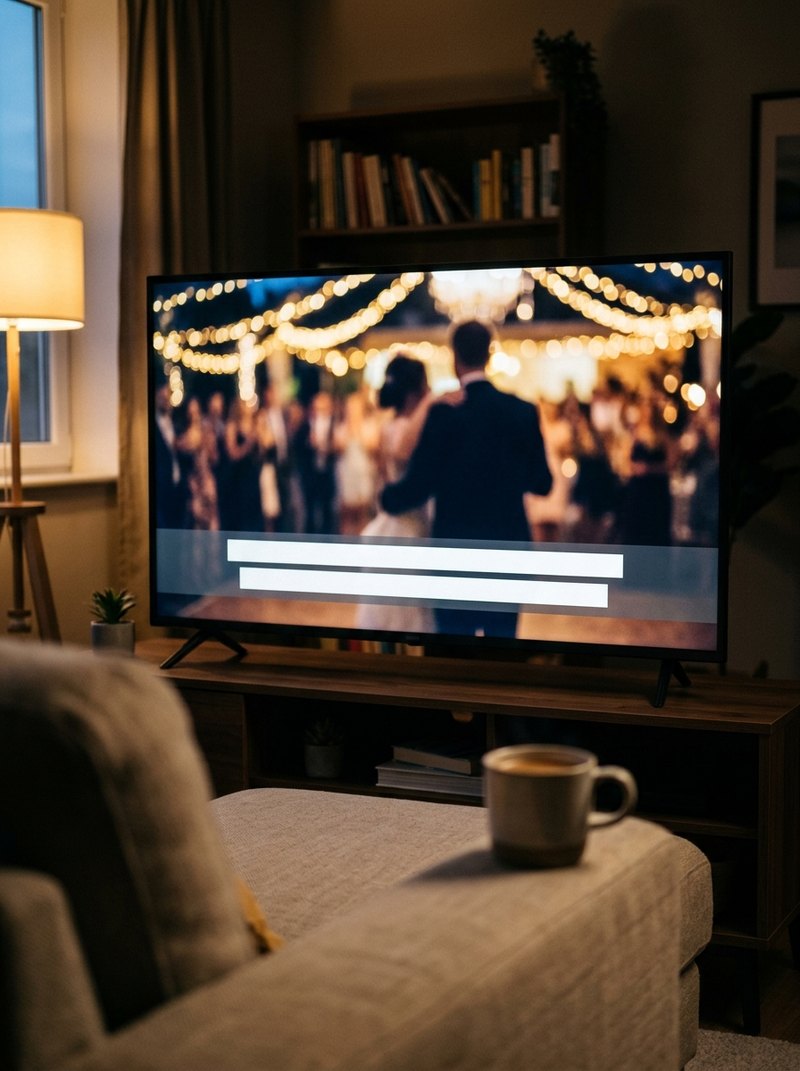
Caption a wedding film whenever someone who will watch it is deaf or hard of hearing, and ask at booking rather than after delivery. Captions are not the same as subtitles: they carry who is speaking and the sounds that matter, not just the words. Deliver them as a caption file the viewer can switch on, add a burned-in copy for anywhere that cannot show one, and check every name by hand before the couple sees it.
Search for this and you find general guides to captioning online video, wedding planning advice on seating deaf guests, and a handful of old forum threads from videographers asked to caption a film for the first time. Almost nothing covers the editing decisions.
Captions or subtitles?
Subtitles translate speech for viewers who can hear but do not understand the language. Captions are for viewers who cannot hear: they include the words, who is speaking when that is not obvious, and the sounds that carry meaning, such as laughter, applause or a song starting.
A bilingual wedding can need both. Translating a toast for one side of the family is subtitling, which we cover in our guide to editing multi-day and cultural weddings. A deaf grandparent watching the same toast needs captions.
Caption file or burned in?
- A caption file, usually SRT or WebVTT, sits beside the film and the viewer switches it on. These are often called closed captions. Most video hosts accept one, and the film stays clean for everyone else.
- Burned-in captions, also called open captions, are part of the picture. They show on any screen, every time, which is why social clips usually carry them.
For the main film, a caption file is usually right. Add a burned-in copy for the version that will be played on a television at a family gathering, where nobody wants to hunt for a caption setting.
Check that the way you deliver the film can carry a caption file at all. A file sent alongside a download is easily separated from the film, and a phone's photo library will not show it.
What do auto captions get wrong?
Automatic captions are a fast first draft and an unreliable final one. A wedding is close to their worst case:
- Names. The couple, the officiant, parents, the venue. Auto captions guess, and they guess wrong in the moments that matter most.
- Overlapping speech and laughter in the toasts and speeches.
- Accents, other languages, and formal readings.
- Music. Lyrics under a first dance get transcribed as if someone had said them.
Captions are also only as good as the audio under them. A clean microphone on the officiant and a recorder on the toast microphone do more for captioning than any software.
Ask the couple for a spelling list at booking: every name, nickname and place likely to be spoken. Then read the captions against the audio before delivery, rather than skimming them.
What should the captions include?
- The vows, readings and speeches as they were said. Leave out pure filler, but never rewrite a line.
- Who is speaking, whenever the speaker is off screen or the shot does not make it obvious.
- Sounds that carry meaning: laughter, applause, a gasp, the music changing.
- Music by description, or by title when the song is part of the moment, as with a first dance.
- Nothing that is already readable on screen.
How do you edit signed vows?
If the couple or the officiant signs, the language is in their hands, and the edit has to keep them. Do not crop to a tight face shot during signed vows, and do not cut away mid-sentence to a reaction shot the way you might during spoken ones. Hold a frame wide enough to keep both hands in it for the whole phrase.
Captions here are a translation for hearing viewers, so place them where they do not cover the hands. If an interpreter voiced the ceremony, the interpreter's audio can drive the captions, but the signing stays the picture.
This starts on the day. Tell your shooters which moments will be signed, so that one angle holds the signer in full.
What should go in the brief?
- Whether anyone watching is deaf or hard of hearing, and whether the couple wants captions on everything or on the ceremony and speeches only.
- Caption file, burned in, or both, and for which deliverables.
- The spelling list.
- Any signed moments, with timestamps, and whether an interpreter's audio exists.
- Lines in other languages, and whether they also need subtitles.
The bottom line
Ask at booking whether anyone watching is deaf or hard of hearing. Caption the words, the speakers and the sounds that matter, check every name by hand, and deliver a caption file plus a burned-in copy for the television.
If the vows are signed, keep the hands in the frame and the captions off them.