Multicam Wedding Ceremony Edits: When to Cut
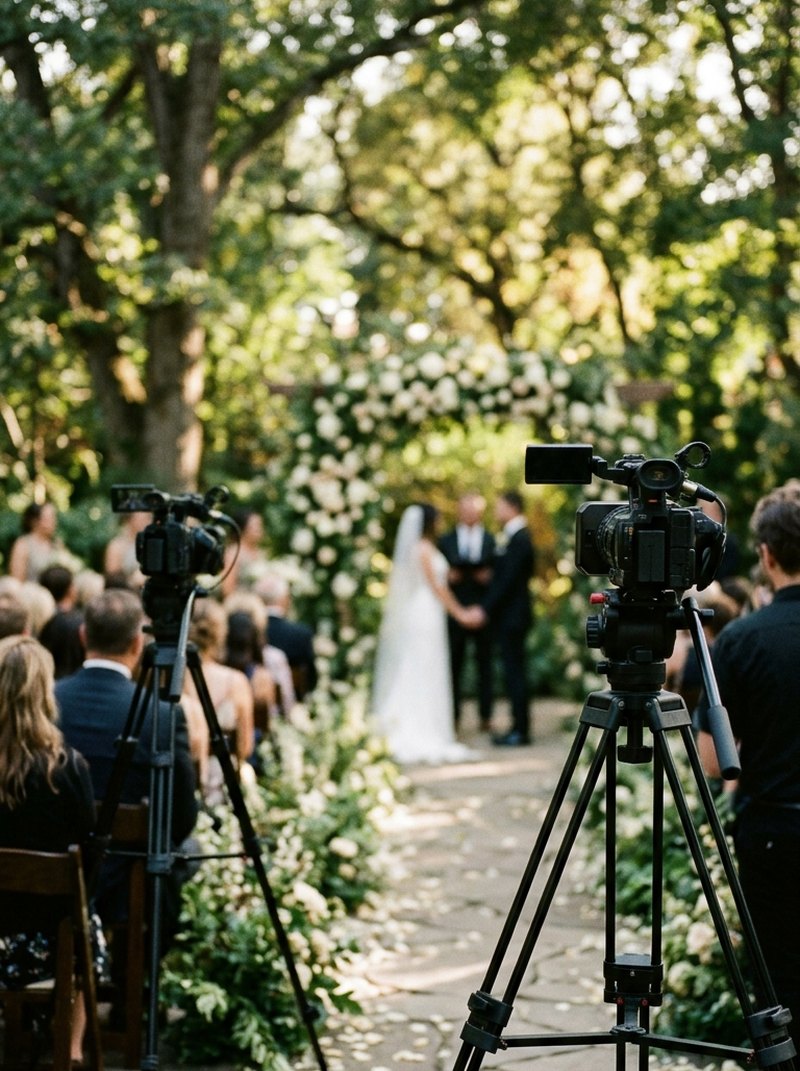
In a multicam ceremony edit, cut when the story moves to someone else or when the shot you are on stops working, and hold otherwise. Having three angles is not a reason to use all three. How often to switch beyond that is partly a matter of taste, which is why it belongs in the brief rather than in the first round of revisions.
Search for this and you find guides to filming a ceremony with two or three cameras and general multicam tutorials for editing software. Very little covers the decision an editor makes on every line of the vows: stay on this angle, or switch.
What job does each camera have?
Before cutting anything, know what each angle is for. A common three-camera ceremony looks like this:
- A wide from the back or the side that sees the couple and the officiant together. It is the safety angle and the one for moments the whole room shares.
- A tight shot on one partner, usually from over the officiant's shoulder.
- A tight shot on the other partner, or a second wide from the front.
Each part of the ceremony then has a main angle: the processional on the aisle camera, the vows on whoever is speaking, the kiss on the wide. The edit sits on the main angle and leaves it for a reason.
When does a cut earn its place?
- The speaker changes. The officiant hands over to a partner, or a reader steps up.
- The reaction is the point. A partner's face while the other reads their vows is often the shot that matters most.
- The current shot fails. Focus misses, the camera is bumped, a guest stands up, or the photographer steps into the frame.
- The moment belongs to the room. The rings, the kiss and the recessional usually play better on the wide.
- The viewer needs to know where things are. An entrance makes more sense on a shot that shows the aisle.
Everything else is a cut for its own sake: switching because a shot has run for a while, or to prove the coverage was there.
How long can you hold one angle?
As long as the shot is working and the same person is the story. A partner reading their vows in one well framed close-up, with no cuts at all, is a legitimate edit and often the strongest one. Cutting away during a held look, or in the middle of a sentence, breaks the attention the vows have earned.
There is no correct number of cuts per minute. Some filmmakers like a ceremony that keeps moving between faces. Others would rather hold on one angle, even an imperfect one, and switch only when something forces it. Both are styles and neither is a mistake. The mistake is an editor having to guess which one you want.
Should you cut away from an imperfect shot?
This is where taste shows most. A shot that is slightly soft, framed a little loose or briefly crossed by the photographer can be held or covered. Covering every flaw produces a ceremony that switches more often than the moment calls for. Holding through every flaw leaves obvious problems on screen.
A reasonable middle: cut away from a flaw that pulls attention from the couple, such as a face out of focus or someone standing in front of the lens, and hold through one that only a filmmaker would notice. Then tell your editor which side of that line you sit on.
Why do some cuts look wrong even on a sentence break?
Usually it is the eyeline. If two cameras sit on opposite sides of the aisle, a partner looking at the officiant faces left in one and right in the other. Cut straight between them and the couple seem to swap places. Cut through the wide instead, or keep the tight shots to cameras on the same side of the couple.
The other cause is two angles that are too alike. A cut between two close-ups of the same face from nearly the same direction reads as a jump rather than a new view. Change the shot size or the angle enough that the switch looks deliberate.
The angles also have to look like one day. A cut is far more visible when the skin tone shifts with it, which is the work of matching multiple cameras.
What happens to the audio when you switch?
Nothing. The picture changes and the sound does not. Lay the vows on the best microphone for each speaker and keep it running under every angle, so a cut never changes how a voice sounds. Where a microphone failed, find out what can be fixed in the audio before you plan the ceremony around it.
Is it different in a highlight and a documentary edit?
Yes. In a documentary edit the ceremony stays whole and in order, so the angles are what keep a long ceremony watchable, and every cut should serve the words. We set out the wider rules in how to edit a wedding documentary.
In a highlight the ceremony shrinks to a few lines and the rhythm usually follows the music, so cuts come faster and land with the track. A pace that feels right in a three minute highlight can feel restless across a full ceremony. Where those lines go is part of the structure of a highlight film.
And with only one camera, every one of these choices becomes the same choice: hold, or punch in. We cover that in editing a wedding film shot on one camera.
What should you tell your editor?
Pacing is the hardest part of a style to describe and the easiest to get wrong, whether you work with a freelancer or a wedding video editing service. Put it in the brief:
- Your default: hold and switch only for a reason, or keep the ceremony moving between faces.
- Which camera is the main angle for each part of the ceremony.
- Whether to cover small flaws or hold through them, and which flaws you always want covered.
- Known problems with timestamps: a bumped camera, a missed focus, the moment the photographer walked in.
- A ceremony from one of your own films, cut the way you like.
If the first cut still misses, say where and which way. 'The vows from 1:10 to 2:30 switch too often, hold on whoever is speaking' is a note an editor can act on. 'The pacing feels off' is not. More on that in giving revision feedback on a wedding film.
The bottom line
Sit on the main angle, and cut when the speaker changes, when the reaction is the point, when the shot fails or when the moment belongs to the room. Beyond that, how often to switch is a matter of taste.
So write your taste down. An editor who knows your pacing from the brief does not have to find it out in revisions.